

Blackout Curtains for Noise Control: What to Expect and Limitations
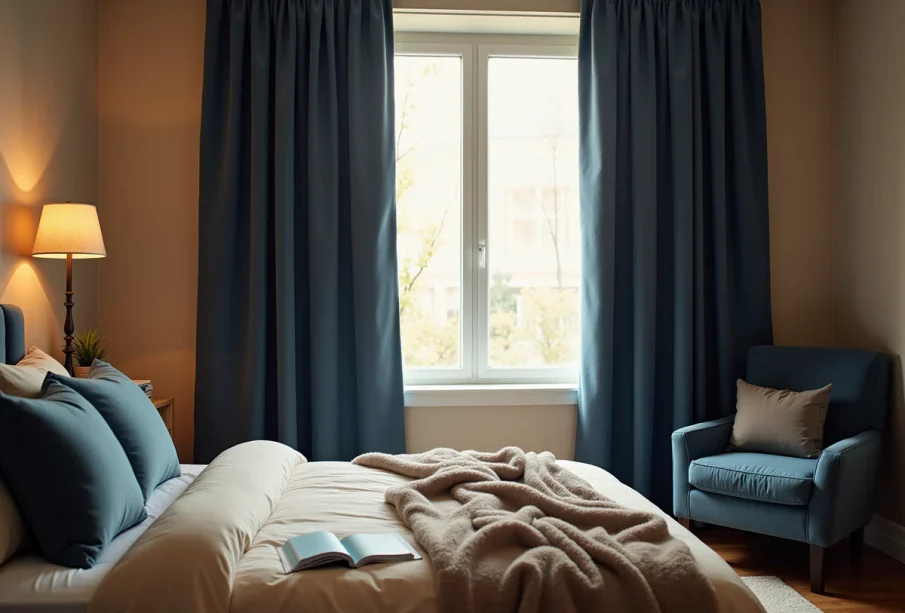
Every conversation about blackout curtains sound reduction eventually arrives at the same place: the gap between what people hope for and what the physics will allow. That gap is worth examining closely, not to discourage anyone from the investment, but because understanding what these curtains actually do, and where their limits lie, is the only way to make a decision that holds up over time. The curtain itself is a deceptively simple object. Fabric, weight, a track or rod, a window to cover. But the interaction between that fabric and the sound waves pressing against it from the outside world is a more nuanced affair than it first appears.
In Singapore, where residential towers rise within metres of elevated expressways and where the ambient noise floor of daily life is rarely low, the question of acoustic comfort in the home is not a minor one. It is the kind of question that keeps people awake, sometimes literally, and that drives genuinely practical decisions about how a home is fitted out.
What Blackout Curtains Actually Do to Sound
The mechanism by which blackout curtains reduce noise is absorption, not elimination. This distinction matters enormously. A curtain does not seal a room. It does not create an acoustic barrier in the engineering sense of the term. What it does is introduce a layer of dense, mass-rich material into the path of incoming sound waves, and that material converts some portion of the wave’s energy into heat through friction within its fibres.
The result is measurable. A well-specified sound-reducing blackout curtain, hung with proper fullness and coverage, can attenuate sound in the range of five to twelve decibels depending on the frequency of the noise and the construction of the fabric. To put that in terms that are easier to grasp: a reduction of ten decibels is perceived by the human ear as roughly halving the loudness of a sound. That is not silence, but it is a meaningful improvement in a bedroom facing a busy road.
The frequencies that respond best to fabric treatment are the mid and upper ranges: the hiss of tyre noise on wet tarmac, the higher registers of conversation drifting up from the street, the sharp intrusions of car horns and motorbike engines. Low-frequency sounds, the deep thrum of heavy vehicles, the bass resonance of construction machinery, the structural vibration of an MRT line running nearby, are considerably harder to attenuate with fabric alone. They require mass and isolation of a different order.
The Factors That Determine Performance
The performance of blackout curtains for noise control is not fixed. It varies considerably depending on a set of factors that are within the homeowner’s control.
Fabric weight and density
This is the foundational variable. Heavier, more tightly constructed fabrics absorb more acoustic energy. A velvet or multi-layered triple-weave blackout fabric will outperform a lightweight polyester panel at almost every frequency. The difference is not marginal.
Fullness and stack
A curtain hung at one and a half to two times the window width creates a layered stack of fabric that is acoustically far more effective than a flat panel. The folds introduce depth, and depth is where absorption happens.
Coverage
The curtain must cover what it is meant to cover, completely. This means:
- Mounting the track or rod close to the ceiling to minimise the gap above the curtain
- Extending the track beyond the window frame on each side so the curtain can wrap around to the wall
- Ensuring the curtain reaches the floor without a gap, or allowing it to puddle slightly
- Using side returns where the layout permits to close the lateral pathways that bypass the fabric entirely
Each of these details represents a potential acoustic leakage point. Sound, like water, finds the path of least resistance. A curtain that leaves a five-centimetre gap at the top and a three-centimetre gap at each side is providing considerably less acoustic benefit than its fabric specification would suggest.
The Honest Limitations
There is a version of the blackout curtains sound reduction conversation that oversells what fabric can accomplish, and it does nobody any favours. The limitations are real and ought to be stated plainly.
Fabric curtains do not address sound transmitted through walls, floors, or ceilings. They work on the window and the air space in front of it, nothing more. In a Singapore HDB flat where noise is entering through a shared wall rather than a window, a curtain is the wrong intervention. In a condominium where impact noise from the unit above is the primary complaint, no amount of window treatment will resolve the problem.
For homes where noise levels are severe, where the window faces a major expressway at close range, or where the source is continuous and intense, sound-reducing curtains should be understood as a supplement to other measures rather than a standalone solution. Secondary glazing, acoustic panels, and white noise systems each address different parts of the acoustic problem and can work alongside well-chosen curtains to produce a result that no single intervention would achieve alone.
Where Blackout Curtains Earn Their Place
None of this diminishes what blackout curtains reliably deliver. For the moderate, persistent noise that characterises most urban residential environments in Singapore, the right curtain, properly installed, makes a room quieter in a way that is perceptible and lasting. Sleep improves. Concentration holds more steadily. The sense that the outside world is pressing in with less insistence creates a quality of interior calm that is genuinely worth having.
Final Thoughts
The story of blackout curtains sound reduction is ultimately a story about appropriate expectations. When those expectations are calibrated accurately, the curtain delivers, consistently and without fuss, precisely what the evidence says it will.